
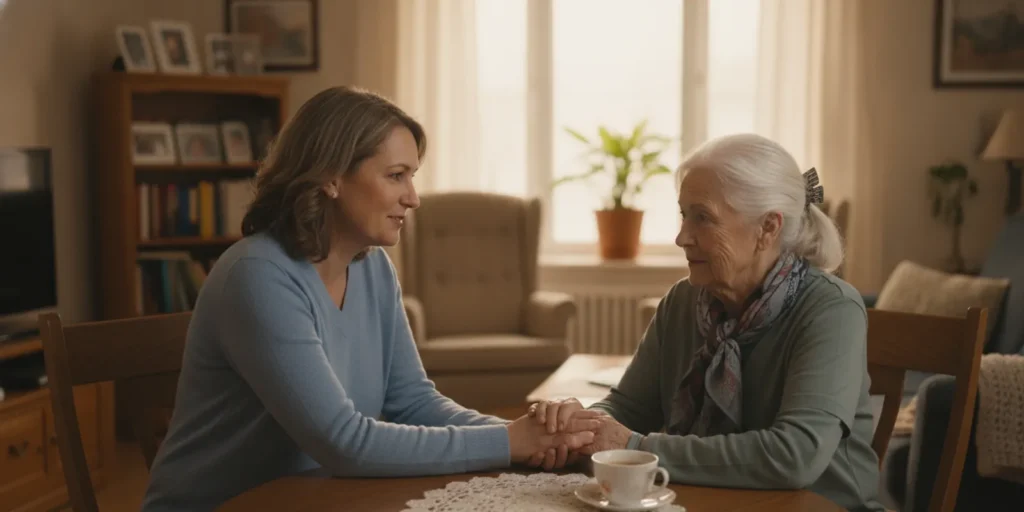
If a loved one is living with dementia or experiencing increasing confusion, you may be asking: what is a memory care facility, and how is it different from other care? A memory care facility is a residential setting organized around support for people with dementia, including help with daily routines and personal care. The exact services, setting, and fit vary by home and by person.
A diagnosis alone does not tell a family which setting is right. A person’s day-to-day needs, preferences, health, safety concerns, and the support available from family all matter. The following guide explains what the term generally means, how it differs from other forms of care, and how to ask a residence whether its approach might fit one individual. It is information for planning a conversation, not a diagnosis or promise of admission.
What does a memory care facility provide?
Memory care is a form of residential support for people living with dementia. Depending on the residence, services may include assistance with activities of daily living, meals, planned activities, medication support, and monitoring intended to support safety. A home may arrange routines with a person’s preferences in mind and help with tasks that have become difficult. These general examples do not mean that every residence provides every service, or that a particular person will be accepted.
Memory care is not automatically a hospital, a skilled nursing facility, or a setting for continuous medical treatment. It does not by itself promise rehabilitation, nursing-level care, or clinical coverage. Families should explain the person’s current needs and ask which the home can support. If needs involve complex or changing medical care, discuss them with the person’s clinician and ask whether another care setting is appropriate.
Dementia is a broad term, and people’s experiences can differ. The National Institute on Aging offers general information about aging and dementia. A diagnosis and its effects differ from person to person, so a care discussion should focus on the person’s actual day rather than a label alone.
How does memory care differ from assisted living?
Assisted living generally supports older adults who need help with daily activities while living in a residential community. Memory care is designed with dementia-related support needs in mind. Some providers offer both types of care, while others focus on one. Even when a provider offers both, the services, routines, room choices, and availability may differ by property.
Consider the kind of support the person needs, not only the name of the care setting. Does the person need occasional reminders and help getting dressed, or do they become disoriented while moving through familiar spaces? Is support with meals or medication routines needed? Would a predictable schedule or familiar activities help the person feel more settled? These details give a residence a clearer picture than a general statement that the person has memory loss.
Shepherd Premier describes memory care as a service at particular homes. Its memory care overview is one starting point for learning about the company’s general approach. Confirm the care type and details for an individual home rather than assuming all locations offer the same services.
How is memory care different from home care, respite, adult day care, and nursing care?
These options address different needs and are not interchangeable. Home care brings assistance into a person’s current residence, if the needed help and schedule can be arranged. Residential memory care means the person lives in a setting where dementia-oriented support is provided. Respite is short-term relief or temporary care, where available. Adult day care provides support during the day rather than a residential place to live. Nursing care is a separate, higher-acuity setting for needs requiring that level of care.
| Option | Where care happens | What to clarify |
|---|---|---|
| Memory care | A residential home or community | Dementia-related support, daily routines, safety practices, services, fit, and current availability |
| Assisted living | A residential setting | Help with daily activities, property-specific services, and whether dementia-related needs can be supported |
| Home care | The person’s current home | Visit schedule, tasks covered, continuity, and what happens when needs change |
| Respite care | A provider’s setting or service, if available | Duration, eligibility, services, cost, and whether a temporary stay is offered |
| Adult day care | A daytime program, where offered | Hours, transportation, activities, eligibility, and support outside program hours |
| Nursing care | A nursing facility or other clinical setting | Clinical needs, eligibility, services, and payment arrangements |
The right comparison depends on the person’s needs and the actual services available. Shepherd Premier’s home care information can help families consider the difference between support at home and residential care. Its respite care guide discusses another distinct option. Ask each provider what it offers rather than assuming a service described in one setting is part of another.
What signs may lead a family to explore memory care?
Families may start exploring when daily support becomes difficult to coordinate or when changes in memory and judgment affect routines and safety. Examples could include repeated difficulty with meals, dressing, medication routines, or navigating familiar spaces. A family caregiver may also find that supervision and hands-on help are becoming hard to provide alongside work, caregiving for others, or the needs of the household.
These examples do not diagnose dementia or establish that a move is needed. A single difficult day does not tell the whole story, and one person’s needs may change over time. Start by noting what is happening, when it happens, what support is already in place, and what seems to help. If changes are new or sudden, contact a healthcare professional. For longer-term planning, discuss the situation with the person, as appropriate, and ask providers whether they can review the described needs.
A conversation is a way to explore possibilities, not a commitment or guarantee of admission. For a broader decision framework, see Shepherd Premier’s guide to considering when more support may be needed. Families can gather information before choosing a move date, and they can return to the discussion as needs and preferences become clearer.
How can you describe a person’s needs clearly?
When families feel worried, it can be hard to summarize what has changed. A short written account can help turn a broad concern into a practical care discussion. Describe a typical day from waking through bedtime. Note what the person does independently, where reminders or hands-on help are needed, and which parts of the day feel challenging.
Use concrete examples rather than general judgments. Instead of saying “he cannot manage meals,” explain whether he forgets to start eating, has trouble preparing food, or needs help getting to the table. Instead of saying “she wanders,” describe where she goes, what seems to prompt the behavior, and what has helped her feel oriented. Avoid interpreting the cause; the purpose is to help a provider understand the support request.
Include strengths and preferences as well as concerns. What can the person still do for themselves? What routines have been important for years? Which activities, foods, music, or familiar objects bring comfort? Does the person prefer a quiet morning, a particular way of being approached, or extra time to complete a task? A useful summary shows the whole person, not just a list of problems.
- List daily tasks and the type of help involved: a reminder, setup, supervision, or hands-on assistance.
- Describe situations that cause worry, including when and where they occur.
- Note communication preferences, familiar routines, and activities the person enjoys.
- Identify questions for the clinician or care provider, keeping medical questions for the appropriate professional.
- Record what the family currently provides and which parts are becoming difficult to sustain.
This preparation does not replace a home’s own review. It helps the conversation begin with specific examples and gives the residence a chance to explain what it can evaluate or support.
What should families ask when comparing memory care?
Bring examples from the person’s current routine and ask how the specific home responds to similar needs. A general description of memory care may not answer what happens at a particular property. Useful questions include:
- Which dementia-related needs can this home support, and which needs would call for another setting?
- How are personal routines, preferences, and familiar activities considered in daily support?
- What help is available with bathing, dressing, meals, mobility, and medication needs at this property?
- How does the home approach disorientation, wandering concerns, and other safety questions?
- What does a typical day look like, and how much flexibility is there for a resident’s established habits?
- How are families kept informed, and whom should they contact with a concern?
- What room options, services, and costs are currently available at this specific home?
- What is included in the quoted rate, and which services may add cost?
- How does the home review whether it can continue to meet a resident’s needs if they change?
- What happens if the home decides it can no longer provide the level of support the person needs?
Ask for specific explanations. For example, if a family is concerned about the person leaving a familiar area, ask what the home’s procedures are and what limits or supports are used. If medication routines are a concern, ask what medication assistance means at that address and what remains the responsibility of the resident or family. Do not infer clinical coverage, staffing patterns, or safety features from a general brochure.
It can be useful to compare answers in writing. Note what the representative said, any follow-up needed, and whether the answer applies to the exact home you are considering. A provider’s general information may not cover every circumstance, and advertised capacity is not a vacancy report. Confirm fit, current availability, and individualized pricing directly with the home.
What can a family notice during a tour?
A tour is an opportunity to see how a residence feels and to ask about daily life. It is not a substitute for a detailed conversation about care needs, and it does not guarantee admission. Before visiting, choose a few priorities. One family may want to understand how residents spend the afternoon; another may want to see the dining area or learn how staff respond when someone needs extra time.
As you visit, observe whether the spaces seem comfortable and understandable for the person. Notice whether it is easy to identify common areas, whether the overall atmosphere feels calm or busy at the time of the visit, and whether residents have opportunities to engage in activities. These are observations from one visit, not proof of what every day or shift is like. Ask how routines change across the day and what activities are offered at the home.
Pay attention to how representatives answer questions. Do they ask about the person’s preferences and current abilities, or speak only in general terms? If you raise a concern, do they explain what they can support and where the limits are? Clear boundaries can be as useful as a positive description because they help a family avoid assumptions. Ask for clarification if an answer is broad or does not address the example you gave.
If the person living with dementia is able and willing to participate, consider what would make the visit comfortable. A shorter visit, familiar companion, or quiet time of day may be easier than a long series of appointments. Give the person time to process what they see. A tour is one step in learning about options, not a decision that must be made on the spot.
How can families prepare for a care conversation?
A short, organized summary can make an initial conversation more useful. Include the person’s typical day, the tasks they manage independently, the help they need, and any situations that cause worry. Note what brings comfort, including preferred routines, foods, activities, and ways of communicating. If there are questions about health or treatment, write them down for the person’s healthcare professional rather than asking a residence to make a diagnosis.
It can also help to decide who is involved in the discussion and what questions are most urgent. If the person has a clinician or care team, ask what information they can share with a provider, with appropriate consent. Family members may hold different views about the right next step. Agreeing on a few shared questions can keep the meeting focused, while recognizing that the person’s wishes and dignity remain important.
When possible, include the person living with dementia in a respectful way. Explain the purpose of the conversation in familiar terms, allow time for questions, and focus on what matters to them. Avoid making promises about a move, a room, or services before the home has reviewed the situation. A calm conversation can be exploratory: the family is learning what the options mean and whether further discussion makes sense.
Shepherd Premier is a family-owned provider serving Illinois and Wisconsin through home-style residences for assisted living and memory care. Its location directory can help identify homes to ask about. Confirm property-specific care types and services, fit, current availability, and pricing directly; the directory is not a vacancy list.
How should families think about cost and availability?
Memory care costs depend on the home, room, services, and the person’s care needs. A starting price, if one is published, is not a personalized quote and may not describe every contract inclusion. Ask for an itemized explanation of the current rate, what services are included, what may cost extra, payment terms, and how a change in care needs could affect cost. Request the information in writing if that will help the family compare options.
Useful cost questions include whether the quoted amount depends on room type, what assistance is covered, whether medication support is included, and which optional or additional services may be charged separately. Ask whether the home reviews rates or charges when a resident’s needs change, and how the family would be notified. These are questions to ask rather than assumptions about a provider’s billing practices.
Discuss payment arrangements directly and do not assume that a benefit or insurance policy will cover a particular residence. Families can ask the provider what payment types it accepts and contact the relevant insurer, benefits administrator, or financial adviser about individual coverage. A provider’s general description cannot determine a person’s eligibility or benefits.
Ask separately about current openings and possible move-in timing. A home’s stated capacity is not the number of available rooms. Availability, room type, care fit, and timing must be confirmed with the particular home. If considering several locations, verify services and terms for each property instead of assuming that they are identical across a provider.
What if needs change after a move?
Care needs may change, so families should ask how a residence reviews whether it can continue to support a resident. Before choosing a home, ask who discusses a change with the family, what information is considered, and how the provider communicates a concern. Also ask what the next step would be if the person needed support that the home does not offer.
Think through a few realistic situations. If a resident needs more help getting ready in the morning, how would the family learn whether the home can adjust support? If a health concern arises, whom should the family contact, and what role does the home play in coordinating with outside professionals? If the person’s needs exceed the home’s scope, how would the family be notified and given time to explore alternatives? The answers will be specific to the provider and property.
It may help to keep a simple record of questions and answers after admission, if a move occurs. Share relevant updates about preferences, routines, and concerns through the home’s stated communication process. Ask for clarification when something has changed or when the family is unsure who is responsible for a task. Good communication does not remove uncertainty, but it can help everyone understand the next step.
How can families compare options without rushing?
Families can organize the decision into stages rather than trying to settle every question at once. First, describe the support needed now and identify any immediate concerns. Next, ask whether a home provides the relevant care and can review the person’s situation. Then compare the routines, services, costs, location, and communication approach. Finally, discuss the information with the person and relevant family members before deciding whether to continue.
- Write down the present situation. Use examples of daily tasks, changes, strengths, and preferences.
- Identify what matters most. Choose the practical needs and personal preferences that should guide a comparison.
- Contact homes with focused questions. Ask about care fit, limitations, services, rates, and current availability at the specific property.
- Visit or request a follow-up. Observe the setting, ask questions that remain unanswered, and include the person when appropriate.
- Review the details together. Separate confirmed facts from questions still awaiting an answer, and avoid treating an initial conversation as a commitment.
For instance, a family might first worry about missed meals and a parent becoming confused while walking through the house. Their notes could distinguish the two concerns: the parent may need reminders and company at meals, while confusion occurs when trying to find a bathroom at night. The family can then ask each residence what it can support, what safety practices apply, and what further assessment is needed. This gives the provider a more useful description than simply asking whether it “takes dementia.”
Another family may be comparing home support with a residential setting because relatives are sharing caregiving duties. They can map the times help is needed, who is currently available, and where gaps occur. A conversation about home care and one about residential memory care may clarify different possibilities, but neither should be judged solely by its name. Compare the actual schedule, services, cost, and fit for the individual.
How can families make a fair comparison between homes?
When several residences are under consideration, memory and stress can make conversations blur together. Use the same short set of questions at each place, then record the answers in a comparison sheet. Include the date, the person who answered, the property discussed, and any detail that still needs confirmation. A note that says “has activities” is less useful than a note that describes which activities are available, when they happen, and how residents are invited to take part.
| Comparison area | What to record | Follow-up question |
|---|---|---|
| Care fit | Needs the home says it can support, and limits it identifies | What review or assessment would clarify the fit? |
| Daily life | Meals, routines, activities, and opportunities for personal choice | How can the person’s preferences shape a typical day? |
| Safety and communication | Practices explained and the family contact process | Who should the family contact when a concern arises? |
| Room and services | Room options and property-specific services mentioned | Which details are currently available and confirmed? |
| Cost and timing | Quoted items, possible additions, and stated availability | Can the home provide a current itemized explanation? |
Keep observation separate from confirmation. A pleasant visit is meaningful, but it does not tell you whether a certain service is included or whether a room is available. Likewise, a representative’s general explanation may be accurate but still need to be checked against the person’s specific needs. Mark answers as confirmed, still to verify, or not applicable. This simple distinction helps prevent a family from treating an assumption as a commitment.
Comparisons should also reflect the individual’s priorities. If maintaining a familiar morning routine is especially important, give that more weight than a feature that does not matter to the person. If a family cannot visit frequently, ask about communication rather than assuming it will happen in a particular way. If a location is far from relatives, consider how travel affects the family’s ability to participate. There is no single scoring system that chooses the right home; the purpose of a comparison is to make trade-offs visible and prompt better questions.
How can a family talk about a possible move with respect?
A care conversation can be emotionally difficult for the person and the people close to them. Family members may feel concern, guilt, relief, or disagreement at the same time. Try to keep the first discussion focused on understanding needs and options rather than winning an argument about a move. Ask what the person values about home, what feels difficult, and what kind of help they would be comfortable considering. Listen for practical worries, such as losing privacy or familiar belongings, as well as feelings that may not have an immediate solution.
Use clear, familiar language and allow pauses. A person may need time to process a question or may be more comfortable discussing one part of the decision at a time. Avoid correcting every detail or overwhelming them with a long list of choices. When helpful, explain the next step in concrete terms: for example, that the family is learning about a residence, not making a decision that day. Adapt the conversation to the person’s communication preferences and involve their trusted supports as appropriate.
When family members disagree, separate shared concerns from different preferences. One relative may focus on safety, while another worries about disruption or cost. Put the questions in a list and seek information from appropriate sources: a clinician for health matters, a residence for its own services and policies, and a financial professional or benefits administrator for individual payment questions. A provider should not be asked to settle family disagreements or determine a medical diagnosis.
Respect also means recognizing the person’s abilities. Ask what tasks they want to continue doing and where help would feel welcome. If a residence is being considered, ask how staff approach privacy, personal choice, and familiar habits in ordinary daily support. These questions do not guarantee a particular outcome, but they bring the conversation back to the person’s experience and dignity.
What should families keep in mind after an initial inquiry?
An inquiry is the beginning of information gathering. A family can ask what information the provider needs next, who will review it, and how to follow up. If the home requests records or a conversation with a clinician, clarify the purpose and obtain the necessary consent. Share only information that is relevant to evaluating care fit, and ask how the provider handles the information it receives.
Before making a decision, distinguish three different questions: whether the property offers the care type being considered, whether the home can support this person’s current needs, and whether the timing and financial details work for the family. A positive answer to one does not automatically answer the others. The provider may need more information to discuss fit, a room may not be available when wanted, or the final cost may depend on room choice and assessed needs.
Ask what the next step means and what it does not mean. A tour is not an admission decision. A preliminary discussion is not necessarily an assessment or written quote. A general service page does not replace property-specific confirmation. When a detail matters to the family, request a direct answer for the particular home and keep a record of what was confirmed.
It is also reasonable to pause and compare options. Families may need to discuss what they learned, consult the person’s healthcare professional about health concerns, or gather financial information. If the situation changes while they are considering options, update the provider and ask whether the earlier information remains applicable. Care conversations are most helpful when they reflect the person’s current circumstances, not an outdated snapshot.
How can families tell what kind of help is actually needed?
It can be useful to separate a task into smaller steps. A person may be able to choose clothes but need help locating them, or may be able to eat independently once a meal is prepared and placed nearby. A family can record whether the challenge is remembering what to do, organizing the steps, reaching or handling an item, or feeling unsettled during the task. This distinction helps families describe what they see without assuming that every difficulty requires the same response.
Look at a routine across several days rather than relying on one example, while noting any urgent concern promptly. A simple log might record the time, activity, what support was offered, and whether it helped. For example: “At breakfast, a reminder to sit at the table helped; the person ate after food was set out.” Or: “At bedtime, the person became confused in the hallway; a familiar light and calm direction helped.” These notes can make a conversation more concrete, but they are not a clinical assessment or a substitute for professional advice.
Also note the difference between a task the person can do safely with time and one that requires another person’s direct support. Rushing to take over may reduce independence; leaving a task unsupported may create a concern. Ask the person what kind of help feels useful, and consider whether a small change in the environment or routine makes the task easier. If a family is uncertain about a change in ability or safety, raise the question with an appropriate healthcare professional.
When speaking with a residence, give both the example and the kind of help that has worked. Ask whether the home can support the task in that way and whether its approach depends on the time of day, the resident’s condition, or available services. Do not assume a residence can offer continuous one-to-one support or any specific staffing arrangement unless the provider confirms it for that property and situation.
What details should families clarify about medication and personal care?
Medication and personal care are common topics in memory-care conversations, but the same phrase can mean different things to different people. Rather than relying on a general label such as “medication management,” ask the home to describe exactly what support it provides, who is responsible for each step, and what information it needs from the family or prescribing professional. Confirm the procedure for questions, changes, missed doses, or concerns, and ask how the home communicates relevant updates. The provider’s explanation should be specific to the property and consistent with its policies.
For bathing, dressing, grooming, toileting, or mobility, describe the task and the person’s preferences. Does the person prefer a certain time of day, need encouragement before beginning, or value privacy while completing part of the task independently? Ask how the home learns those preferences and how it responds if the person declines help. A respectful care discussion recognizes the person’s boundaries while making room to talk about support and safety. Do not assume a service is available simply because it is common in some residential settings.
Families can bring a written list of questions and leave space to record the answer. Useful follow-ups include: “Does that service apply at this home?” “What would the resident or family still handle?” and “Who should we speak with if the need changes?” If an answer is unclear, ask for an example of how the process works in an ordinary situation. Clinical questions about medication or personal health should go to the person’s healthcare professional.
These details matter because a broad service description may conceal a difference between assistance, reminders, and a task performed by another person. Understanding the boundary helps a family compare care honestly, discuss the person’s preferences, and decide whether a provider should review the situation further.
Frequently asked questions
Is memory care only for people with Alzheimer’s disease?
No. Memory care is intended for people with dementia-related support needs; Alzheimer’s disease is one form of dementia. Whether a particular home can support an individual depends on its services and review of that person’s needs.
Does memory care provide medical treatment?
Memory care is residential support, not automatically a substitute for a hospital, skilled nursing, or other clinical care. Ask the home what medication support and outside medical coordination it offers, and discuss clinical questions with the person’s healthcare professional.
Can a person move from assisted living to memory care?
Some providers offer both care types, but availability and transitions depend on the property and the person’s needs. Ask the specific home how it reviews changing needs and whether it currently offers the relevant care.
Does a memory care tour mean a person will be admitted?
No. A tour or care conversation helps a family learn about the home and discuss fit. Admission, timing, and pricing require a home-specific review and confirmation.
How soon should a family start asking questions?
There is no single timeline that fits every family. It is reasonable to start gathering information when daily support or safety concerns arise, even if no move is planned. If a change is sudden or raises a medical concern, contact a healthcare professional promptly.
Memory care is one possible form of support, and a thoughtful next step is to discuss the person’s needs, preferences, and the services available at a specific home.