Activities for seniors can be much more than ways to fill an afternoon. A familiar song, a short walk, helping set the table, or a quiet conversation may offer a welcome point of connection. The most useful activity is not necessarily the busiest or most elaborate. It is one that fits the person’s interests, abilities, energy, and preferences that day.
For families comparing senior living, the activity calendar is only part of the picture. It helps to learn how a home gets to know each resident, how it makes participation comfortable, and what happens when someone would rather observe or rest. This guide shares practical ways to think about activities and questions to ask while exploring care.
What makes an activity meaningful for an older adult?
An activity can be meaningful because it connects with a person’s history, offers a manageable challenge, supports a relationship, or brings a familiar rhythm to the day. It does not have to produce a finished craft, involve a group, or look impressive to visitors. A person may value the process more than the result.
Start with the individual rather than a list of popular senior activities. Consider what the person has enjoyed over time and what they choose now. Someone who loved gardening might enjoy arranging flowers, looking through seed catalogs, watering a container plant, or talking about a favorite garden. A former cook may like discussing recipes, folding napkins, or helping with a simple food-related task if it is appropriate for the setting and the person’s needs.
Interests may change. A person who once enjoyed a large card group might now prefer a short game with one other person. Someone who has never considered themselves an artist might enjoy choosing colors or watching a demonstration without being expected to make anything. Ask, notice, and adjust instead of assuming that past preferences are permanent instructions. Meaning can be quiet, too. Listening to a familiar radio program, looking at family photographs, sitting near a window, or sharing a few minutes of conversation may be satisfying. These choices deserve respect alongside group events and structured programs.
How can families learn what a person enjoys?
Useful activity planning begins with a conversation, but it does not end there. Some people can readily name what they like. Others may need choices, time, or a chance to try something before they know how they feel about it. Families can help by sharing specific observations rather than broad labels such as “likes music” or “doesn’t do groups.” Try asking what the person liked doing on an ordinary afternoon, which hobbies or family traditions mattered, and whether they prefer doing something with others, alongside someone, or on their own. Ask what settings feel comfortable and whether there are activities they would rather avoid.
Memories can offer clues, but they should not be treated as a prescription. A person who used to sew may not want to sew now. Someone who enjoyed sports may prefer to watch rather than participate. Ask whether an idea sounds appealing today, and accept a change of mind. Notice what draws the person’s attention without turning observation into a test. Do they linger when music is playing? Do they enjoy talking while looking at photographs? Do they seem more comfortable with one familiar companion than in a busy room? Share such details with the care team, while remembering that a single response does not define what the person will always enjoy.
For a family conversation, write down a few examples under three headings: “likes,” “might try,” and “does not enjoy.” Include practical preferences too, such as the best time of day, preferred pace, and whether the person likes advance notice. Keep the notes flexible. A favorite activity can stop appealing, and something new may become interesting. Invite the older adult to correct the family’s understanding whenever possible.
How should an activity fit a person’s abilities and energy?
The goal is not to make every activity easy or to avoid every challenge. It is to find a comfortable way for someone to take part without making the activity feel confusing, tiring, or pressured. A familiar task can be adjusted in small ways: shorten it, simplify the steps, offer a choice between two materials, or invite the person to watch first. Energy can vary from day to day and throughout the day. Families can ask whether activities have shorter or quieter versions and whether residents can join late or leave early.
Accessibility is another practical consideration. Ask how a space and activity can be adapted to the person’s mobility, hearing, vision, dexterity, or communication preferences. The details depend on the individual and the particular home. Avoid assuming a program is suitable simply because it is listed on a calendar. A tabletop game may be easier with larger pieces, fewer steps, or a partner who explains each turn calmly. A music activity might work better at a lower volume or in a smaller group. A movement activity might have seated options, if the provider confirms that those are appropriate for the person. These are conversation starters, not clinical recommendations. Ask appropriate health professionals about concerns involving a specific person’s health or safety.
Distinguish between doing something independently and doing it with support. A person may enjoy choosing ingredients, folding towels, or arranging objects when someone else sets up the materials or stays nearby. Ask whether there are ordinary, purposeful ways to participate in daily life, not just scheduled entertainment. A lively morning person may prefer a morning option; someone who needs a slower start may appreciate an unhurried choice later. The right pace and timing should be discussed with the person rather than assumed.
What kinds of activities can support connection and purpose?
There is no single activity list that suits every older adult. A balanced set of possibilities might include social, creative, sensory, practical, reflective, and movement-based choices. The right mix depends on the person’s wishes, abilities, comfort, and the options a particular home can safely provide.
Social activities
Conversation, a small-group game, a shared meal, or a visit with family can create a natural reason to be together. Some people enjoy a lively group; others find it easier to connect with one person at a time. Sitting with others while listening or watching may be a comfortable first step. A person can be included without being asked to speak or perform. If the person prefers quiet, a calm one-to-one visit may be more welcome than a large gathering.
Creative and hands-on activities
Drawing, coloring, arranging flowers, simple crafts, or working with photographs can give someone a chance to make choices and use familiar skills. There is no need to judge the result. Offer materials in an accessible way, keep instructions simple, and let the person decide whether to continue. Some people enjoy practical tasks that have a clear purpose, such as folding cloth napkins or sorting greeting cards. Whether a task is suitable depends on the setting and the person. Ask what residents may choose to help with, and do not assume every home or resident can participate in the same way.
Music, stories, and familiar routines
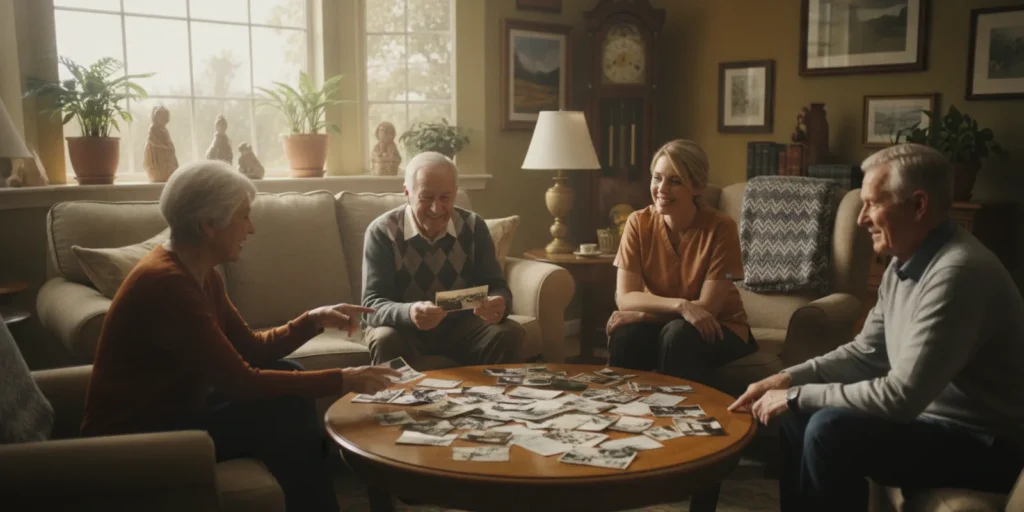
Listening to familiar music, singing along, talking about a meaningful place, or sharing a family story can invite connection without requiring complex instructions. Familiar songs may bring up strong feelings as well as pleasant memories. Let the person’s response guide whether to continue, change the music, or move to something else. Photographs and keepsakes can help start a conversation, but offer them gently. A person may not recognize everyone or may not want to talk about the past. Avoid quizzing or correcting; follow the person’s lead.
Purpose can come from everyday choices: selecting a sweater, choosing between two activities, deciding where to sit, or helping plan a visit. A weekly call, a particular kind of music with breakfast, or reading after lunch may be a familiar routine worth discussing. These moments may not appear on a formal calendar, so ask how staff learn a person’s preferences and make room for them where possible.
Movement and time outdoors
Some older adults enjoy gentle movement, stretching, walking, gardening, or watching an outdoor activity. Others may prefer a seated activity or time outside without a planned exercise goal. The pace, location, supervision, and suitability should be discussed with the home and, when appropriate, the person’s health professionals. Do not assume an activity is safe for an individual based on its general description. Ask whether a home has an outdoor area, how residents access it, and what arrangements or limits apply at that specific residence.
How can activities feel welcoming rather than demanding?
An invitation should leave room for choice. If someone declines, acknowledge the answer and offer another possibility later. Repeatedly urging a person to join can make an activity feel like an obligation. A gentle invitation with a clear description may help someone decide when an activity is unfamiliar. Instead of saying, “Come to the program,” try, “We’re looking at old movie posters in the sitting room. Would you like to join us or see them later?” Offering two simple options can make a decision easier without taking control away from the person.
Consider the environment as well as the activity. A room may be noisy, crowded, or unfamiliar, or a group may be larger than someone prefers. A quieter corner or a short visit may make it easier to try an event. Ask the home whether adjustments are possible and how staff respond if a resident becomes uncomfortable. For people who have difficulty following long directions, a demonstration or one step at a time may be more inviting than a detailed explanation. Give the person time to respond. Avoid speaking about them as if they are not present, and do not treat a slower response as a lack of interest.
Participation can look different from one day to another. Someone might join a group one week, observe the next week, and choose a one-to-one activity later. A flexible approach recognizes that enjoyment is not measured by attendance or by how long someone stays. The aim is to offer a respectful choice, not to reach a target number of activities.
How can families make a first invitation easier?
A new activity can feel easier when a family member explains what will happen in concrete, low-pressure terms. Rather than saying, “There is a social event at two,” describe the setting and the choice: “A few people will be listening to music in the lounge after lunch. We can stop in for a song, or we can stay here.” That gives the person an idea of the group size, activity, and possible duration without promising details the family has not confirmed. If an event is unfamiliar, ask whether the person would like to see the room beforehand or meet one participant before joining.
Prepare only what is useful. For a familiar craft, that might mean placing two colors of paper on the table rather than bringing a large kit with many small pieces. For a conversation, a photograph or a simple question can provide a starting point, but the person does not need to complete a task or tell a particular story. Keep an easy alternative ready, such as sitting together or listening quietly. If the person becomes distracted or wants to stop, close the activity warmly: “We can put this away and do something else.” A calm ending can help preserve choice and comfort.
Families can also ask staff how an activity is introduced to someone new. Does a staff member explain it individually, offer a chance to watch, or help the resident find a comfortable seat? What happens if the activity is already underway when the resident arrives? These small details can make the difference between an open invitation and a moment that feels confusing. The answer will depend on the home and its current routines, so ask about the specific setting rather than assuming that every program is introduced in the same way.
How can families think about activities when memory needs are present?
When a person is living with dementia, an activity may be easier to approach when it feels familiar, offers a simple point of focus, and can be adapted as needed. Needs and preferences differ from person to person. No single activity is right for everyone, and an activity should not be presented as a treatment or a guaranteed way to change a health condition. Families can share what helps the person feel at ease, which topics or sounds they enjoy, and what may be upsetting. A familiar object, a favorite song, or a short conversation about a well-loved interest may be a useful starting point.
Notice emotional cues. If the person seems interested or relaxed, the activity may be worth continuing. If they appear frustrated, tired, or distressed, pause and offer another choice. Do not insist on finishing a task. Ask the home how it adapts group events, whether a resident can watch without joining, what quieter alternatives may be possible, and how staff respond when someone wants to leave. Shepherd Premier describes memory care as a service offered at particular homes, and its memory care information can help families begin learning about that care type. Confirm the appropriate service, current offerings, and suitability directly for the particular location and individual. Assisted living and memory care are distinct services, and a website overview does not determine which option is right for a person.
What should families ask about activities during a tour?
A tour is a chance to ask how activities work in everyday life, not only to look at a printed calendar. Ask how the home learns a new resident’s interests and routines; whether residents can suggest activities; what choices exist for someone who prefers a small group, one-to-one time, or quiet; and whether a resident can observe first, join partway, or leave when they choose. Ask how activities are adapted for communication, mobility, hearing, or vision needs, and how staff respond when someone declines or becomes uncomfortable.
Ask which activities are usually available at that particular home and which depend on the day, season, or other local factors. Find out how preferences are shared with family members and how the home learns whether something is enjoyable. Listen for a clear explanation of how the team gets to know residents and makes adjustments. A calendar can tell you what is planned; it cannot explain whether a person can participate comfortably, what alternatives exist, or how the home handles a change of mind.
Families comparing locations can review Shepherd Premier’s senior living locations page, then confirm each home’s care type and current details directly. The directory is a starting point, not a substitute for a conversation about the person’s needs or a check of present-day offerings. Ask what is not included, too. A particular event, outdoor option, or support may vary by home or schedule. Clarifying limits is more useful than assuming every general activity happens at every location.
How can activities fit into a broader care decision?
Activities matter, but they are one part of a larger decision about daily support. Families should also understand the services provided at a particular home, how personal care needs are discussed, what routines can be accommodated, and what costs and availability apply. A welcoming activity calendar cannot answer those questions on its own. Write down the person’s priorities before comparing options. One family may focus on familiar routines and visits; another may want to understand the mix of group and individual activities. Keep the person’s own wishes at the center where possible.
When reviewing assisted living, ask what daily support the specific home provides and how activity options fit that setting. Shepherd Premier’s assisted living information introduces the service, but particular services and activity offerings should be confirmed at the home you are considering. Assisted living is not the same as nursing care, and a care conversation is needed to discuss an individual’s situation and fit.
For a helpful comparison, describe a typical day the person enjoys and a typical day that feels difficult. Ask what parts of that routine may be possible, what would need to change, and what is not offered. If the person enjoys one-to-one conversation, find out how that preference could be supported. If they want access to a garden, ask about the specific residence and any practical limits. This makes it easier to discuss realistic expectations without assuming that every preference can be accommodated exactly as it is at home.
What if a person does not want to join activities?
Declining an activity does not automatically mean that something is wrong or that the person is not being included. They may be tired, uninterested, uncomfortable in a group, or simply choosing a quiet moment. Ask what they would prefer instead and respect the answer. For a new activity, consider a low-pressure introduction: describe it in a sentence, invite the person to watch, or offer a short trial. If it does not suit them, try something else another time.
If a person who usually enjoys certain activities seems persistently withdrawn or unhappy, families can share observations with the appropriate care team and ask what they are noticing. A change in interest can have many possible explanations. This article cannot identify the cause or offer a diagnosis. A qualified professional can help address health-related concerns.
How can families encourage meaningful participation?
Families can contribute by sharing useful details and making visits personal. Bring a familiar photograph, talk about a shared interest, or ask the person to help choose what to do together. Keep plans simple enough to allow conversation and breaks. When sharing preferences with a home, give examples rather than broad instructions. “She likes music” is less useful than “She often enjoys quiet old-time radio in the afternoon, but loud groups can feel tiring.” The home can then discuss what might be suitable in that setting.
Families should be open to learning that an old favorite no longer appeals. Preferences may shift, and residents should not be expected to repeat a hobby simply because it once mattered. Ask periodically what feels enjoyable now. If the person has difficulty answering, offer a small number of concrete choices and observe their response with care. The person’s participation belongs to them. Families can offer ideas and share history, but should avoid speaking over the resident when the person can express a preference.
How can families make an activity plan practical?
A simple planning method can keep the conversation focused without turning leisure into a checklist. Write down a few things the person enjoys, a few things they might consider, and anything they clearly do not want. Add practical notes about timing, pace, group size, and the kind of support that makes participation easier. The goal is a useful starting point, not a fixed schedule.
For example, a family might note that a relative enjoys talking about gardening, prefers a small group, and is usually more alert after lunch. They could ask whether the home has a relevant activity or whether a family visit could include arranging flowers. If the person does not enjoy the activity that day, another option can be offered. This example helps organize questions; it does not mean that a particular home provides gardening or flower arranging.
It can be useful to separate preferences from assumptions. “She needs to be kept busy” is an interpretation. “She smiles when she sorts family photographs with her sister” is an observation. Specific observations give a care team something concrete to discuss. Families can revisit their notes after a move or change in routine. A person may want more quiet time while getting used to a new place, or become interested in an option that was not available before. Ask for feedback and make changes with the person rather than treating the first plan as final.
How can a family review whether an activity is working?
Use simple observations rather than judging success by whether the person finishes a project or stays for an entire event. Did they seem comfortable when the activity began? Did they make choices, show curiosity, or enjoy being near others? Did they appear tired or ready to leave? These questions can help a family decide whether to repeat the idea, change the setup, or offer something else. A single experience is only one clue. The person may feel differently at another time of day or in another setting.
After trying an activity, make a brief note of what was offered, when it happened, and what the person seemed to prefer. For instance, “Looked at three family photos after lunch; enjoyed naming the garden, then wanted to rest” is more useful than “Loved photos.” The detail helps avoid turning one positive moment into a fixed expectation. If the person disliked an activity, note what part seemed difficult: the room was noisy, the instructions were long, or the task required more hand movement than comfortable. Discuss observations with staff when relevant, and invite the older adult to share their own view.
Keep the review collaborative. A family can ask, “Would you like to try that again, do it differently, or choose something else?” If the person does not want to answer, offer time rather than pressing for a decision. The care team may have observations from other days, while family members may know a person’s longstanding preferences. Combining those perspectives can guide a better next question, but the person’s current comfort remains important. Do not use an activity log as a scorecard or expect a resident to demonstrate engagement for visitors.
How should families compare activity calendars?
It is tempting to count how many events appear on each calendar. A longer calendar may show that many activities are planned, but it does not tell a family whether the events match a person’s interests or how someone can participate. Look for a range of choices and ask what happens in practice. Notice whether the calendar includes social gatherings, creative options, music, discussion, quiet pursuits, or movement. A list alone cannot confirm that an event happens every week, suits an individual, or offers needed adjustments.
Ask whether residents help choose upcoming activities and how a new resident can learn what is happening without feeling pressure to attend. Families can use the same example at each visit: describe a person who enjoys music but prefers a quiet setting, then ask how participation might work at that home. Comparing specific answers is often more informative than comparing event names. Ask what the calendar does not show, too. Informal moments may happen outside scheduled programs, while a listed event may depend on staffing, season, weather, or other local factors. Seek a clear explanation of current practice rather than treating an example as a promise about future availability.
How can a family visit include an activity without taking over?
Start by asking what the person would like to do during the visit. Bring one or two simple options rather than a large bag of supplies. A favorite book, a few photographs, or a small puzzle might work for some people, while another person may prefer to talk or sit quietly. Let the resident set the pace. If they want to tell a story, listen rather than steering the conversation toward a planned task. If they lose interest, put materials away without making the moment feel like a failure.
Check with the home before bringing food, equipment, plants, or other items that could affect the setting or a resident’s safety. Ask whether there are guidelines for shared spaces and whether a proposed activity fits the person’s support needs. After a visit, reflect on what seemed to make the person comfortable, but avoid turning the next visit into a test. Preferences can vary. Share useful observations with the home when appropriate, and continue to ask the person what they would like.
Request a care conversation about your family’s needs
Frequently asked questions
What are some simple activities for seniors at home or in a care setting?
Options might include looking at photographs, listening to familiar music, having a conversation, choosing flowers, playing a simple game, or helping with an appropriate everyday task. The best choice depends on the individual’s preferences, abilities, energy, and setting. Offer choices and adjust or stop if the person is uncomfortable.
How many activities should an older adult do each day?
There is no single number that suits everyone. Some people enjoy a full schedule, while others prefer a few short activities and substantial quiet time. Focus on whether the person feels comfortable and has choices, rather than counting events or measuring participation against someone else.
How can a family help someone who is hesitant to join a group?
Ask what feels uncomfortable and offer alternatives without pressure. The person might prefer a one-to-one visit, a smaller group, a chance to observe first, or a shorter stay. Ask the home what options are available at that location and respect the person’s decision to decline.
Do activities for people living with dementia need to be different?
Activities may need to be adapted to a person’s changing preferences, communication, abilities, and comfort. Familiar, flexible options can be a starting point, but there is no universal activity plan. Share what you know with the care team and ask how the specific home personalizes participation.
Does an activity calendar show what a resident will be able to do?
Not by itself. A calendar describes plans, but a family should ask how activities are adapted, what alternatives exist, and whether a particular resident can participate comfortably. Confirm current offerings and support with the specific home.
What is a helpful next step?
Choose a few questions that matter most to your family, share what the older adult enjoys, and ask how a particular home would make participation comfortable and meaningful. A personal care conversation or tour can help you understand local options and discuss individual fit; it does not guarantee admission or a particular activity schedule. The person’s preferences should remain part of the discussion at every step.