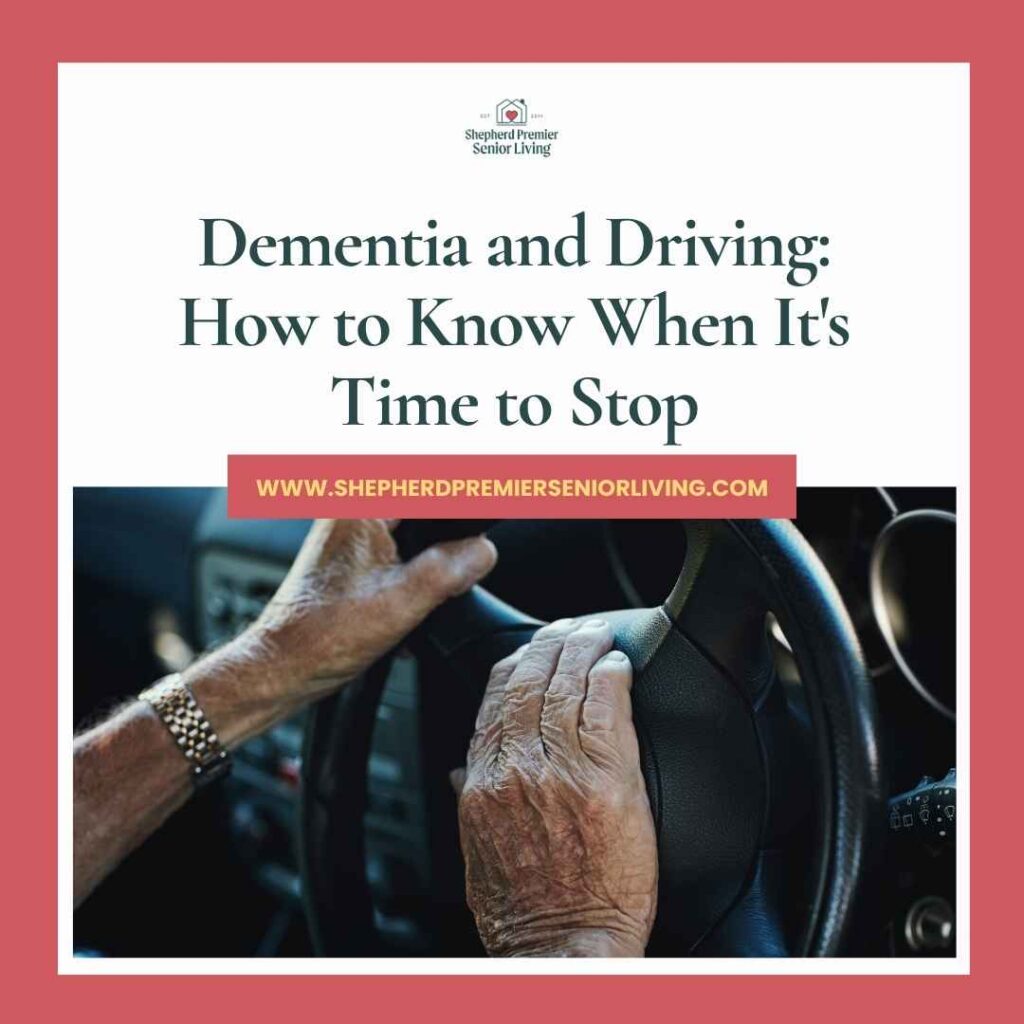
A dementia diagnosis does not automatically mean your parent has to stop driving today. In the early stages, many people continue to drive safely for a while. What a diagnosis does mean is that the ability will decline, and that someone in the family needs to be paying attention on purpose rather than waiting for a phone call from a police officer.
This is one of the hardest conversations families have, and it is hard for a reason. Driving is not really about driving. It is about grocery runs, church, the barber, visiting a friend, and the ability to leave the house without asking permission. When you ask for the keys, you are asking for something much larger than the keys.
What dementia actually takes away behind the wheel
People often assume the risk is forgetting how to drive. It rarely starts there. Driving is a deeply practiced habit, and the mechanics of it survive long after other abilities fade. What erodes first are the judgment skills that sit underneath the habit.
- Divided attention. Tracking a merging car, a changing light, and a pedestrian at the same time.
- Reaction time. The gap between seeing a problem and doing something about it.
- Spatial judgment. Knowing how much room the car actually needs.
- Visual processing. Not what the eyes see, but how quickly the brain makes sense of it.
- Navigation and sequencing. Holding a route in mind while also operating the vehicle.
This is why a person with early dementia can pass a vision test, drive a familiar route perfectly at 10 a.m. on a Tuesday, and still be genuinely unsafe in construction traffic or an unexpected detour. The National Institute on Aging notes that dementia affects driving skills gradually and unpredictably, which is exactly what makes it so difficult for families to judge.
The warning signs worth writing down
Vague worry is hard to act on and easy to argue with. Specific, dated observations are not. If you are concerned, start keeping a short note on your phone every time something happens. Within a month you will either have reassurance, or you will have a clear pattern.
- New dents, scrapes, or scuffs on the car, the garage frame or the mailbox, especially ones your parent cannot explain
- Getting lost on a route they have driven for decades
- Drifting between lanes, or riding the center line
- Stopping at green lights, or rolling through stop signs and red lights
- Confusing the gas and brake pedals, even once
- Driving far below the speed limit on a road where that is its own hazard
- Other drivers honking more often, or passengers feeling nervous
- Getting angry, agitated, or disoriented in traffic in a way that is new
- Quietly giving up night driving, highway driving or left turns, which often signals that they already know something is wrong
- A ticket or a minor collision, which for a driver with dementia is rarely a one-time event
That last one matters more than families expect. When someone starts avoiding highways and left turns on their own, they are usually not being cautious. They are compensating.
Get an objective read before it becomes a family argument
The single most useful thing you can do is take the decision out of the family and hand it to someone neutral. Two options are worth knowing about.
- Talk to their physician. A doctor can evaluate whether the changes you are seeing are dementia related or caused by something else entirely, including medication interactions, vision changes, sleep problems or an infection. Some of those are treatable, and some produce driving problems that resolve once addressed.
- Ask about a driving evaluation. Occupational therapists who specialize in driver rehabilitation can perform a formal on-road and clinical assessment. The result is a professional opinion rather than a child’s opinion, and that difference changes the entire conversation. It also sometimes produces a middle path, such as daytime-only or local-only driving with a recheck in six months.
How Illinois handles older drivers, and what changed recently
Illinois rules on this changed in 2026, so it is worth knowing where things actually stand rather than going on what you remember.
Under the Road Safety and Fairness Act, Illinois ended mandatory road tests for drivers ages 79 through 86. Those drivers now renew with a vision screening rather than an automatic behind-the-wheel test. Drivers 87 and older are still required to take a road test annually.
The same law widened who can raise a concern. Previously, a report about a potentially unsafe driver could only come from a physician, law enforcement, or a state’s attorney. Now an immediate family member, meaning a spouse, parent, grandparent, sibling, or child, can submit medical information to the Illinois Secretary of State for review.
That is a real option for families who have exhausted every conversation and still believe someone is in danger. It is not a small step and it can strain a relationship, so most families should treat it as a last resort rather than a first move. Because these requirements were recently revised, confirm the current process directly with the Illinois Secretary of State before acting.
How to have the conversation
There is no script that makes this painless. There are approaches that make it go better.
Start earlier than feels necessary
The best time to raise it is before there is a crisis, while your parent still has the cognitive ability to participate in the decision. Ask what they would want to happen if driving ever became unsafe. Agreeing to a plan in the abstract is far easier than surrendering to one in the moment.
Lead with the specific, not the diagnosis
“You have dementia, so you can’t drive” invites a fight about the diagnosis. “On Sunday you turned the wrong way onto Route 14 and didn’t realize it until I said something, and that scared me” is much harder to dismiss, because it happened.
Pick one messenger
Four adult children raising it at a holiday dinner feels like an ambush. One person, in private, at a calm moment, has a much better chance.
Solve the real problem out loud
Before you ask for the keys, have an answer to “then how do I get to my appointment on Thursday?” Name the rides. Many Illinois counties, including the ones around our homes, have township or county senior transportation programs, and the Illinois Department on Aging maintains a statewide network of Area Agencies on Aging that can point you to local options. A concrete replacement plan turns a loss into a change of logistics.
Expect to repeat it
With memory loss, one good conversation may not stick. This is usually not stubbornness. If your parent genuinely does not remember agreeing, arguing about what was said last week goes nowhere. Some families find it easier to make the car quietly unavailable than to re-litigate the decision every morning.
When driving is a signal about something larger
Losing the keys is rarely an isolated event. It usually arrives alongside other changes: meals getting simpler or skipped, medications getting confusing, the house getting harder to keep up, days getting quieter and more isolated. Once someone cannot drive, the informal support that made living alone workable often stops being enough.
That does not mean a move is the answer. It means it is a reasonable time to look honestly at the whole picture rather than just the car. If you are not sure where your family stands, our care assessment is a short, no-pressure way to think it through. It may also help to read about the early signs of dementia and what to do after a dementia diagnosis.
For families who reach the point where living at home is no longer safe, Shepherd Premier offers memory care in small residential homes at Dixon and Sterling, and assisted living in Crystal Lake, Harvard, and Oregon.
Common questions
Does a dementia diagnosis automatically revoke an Illinois driver’s license?
No. A diagnosis by itself does not end driving privileges in Illinois. What can lead to a license being restricted or withdrawn is a medical review finding that the person is not able to drive safely. The diagnosis starts the monitoring, not the revocation.
My parent refuses to stop, and there have been no accidents yet. Am I overreacting?
Waiting for an accident is not a safety plan. If you are seeing several of the warning signs above, the responsible next step is a professional evaluation, not a bet that the pattern will hold. An objective assessment also protects you: if the result is that driving is still safe for now, you get to stop worrying with something better than a guess.
Can someone with early dementia keep driving with limits?
Sometimes, for a period. Daytime only, familiar routes only, no highways, and no passengers are common interim arrangements. The key word is interim. Dementia is progressive, so any arrangement needs a scheduled recheck rather than being treated as permanent.
Is it wrong to disable the car instead of asking?
Families wrestle with this, and reasonable people land in different places. The honest framing is that when memory loss makes an agreement impossible to hold onto, the choice is often between an uncomfortable action and a genuine risk to your parent and to other people on the road. Talk it through with their physician, and if it helps, let the recommendation come from the doctor rather than from you.
When should we involve a healthcare professional?
Any time driving behavior changes noticeably, and always before assuming a change is “just aging.” Sudden confusion, a new unsteadiness, or a rapid change in alertness can point to a medical problem that needs attention quickly. Nothing in this article is medical advice, and your parent’s physician is the right person to evaluate their specific situation.
Talk it through with someone who has seen this before
If you are somewhere between “a little worried” and “we need to do something,” you do not have to sort it out alone. Call or text us at (847) 961-2551 for a care conversation, take the care assessment, or schedule a private tour of one of our homes. There is no cost and no obligation, and plenty of the families we talk with are not ready to move anyone anywhere. They just want a straight answer about what they are looking at.
Sources
- National Institute on Aging, Older Drivers and Driving Safety and Alzheimer’s Disease
- Alzheimer’s Association, Dementia and Driving
- Illinois Secretary of State, Understanding Illinois’ Road Safety and Fairness Act and Senior Services
- Illinois Department on Aging, Area Agencies on Aging and transportation resources
This article is for general information and is not medical or legal advice. Please talk with your loved one’s physician about their specific situation.