
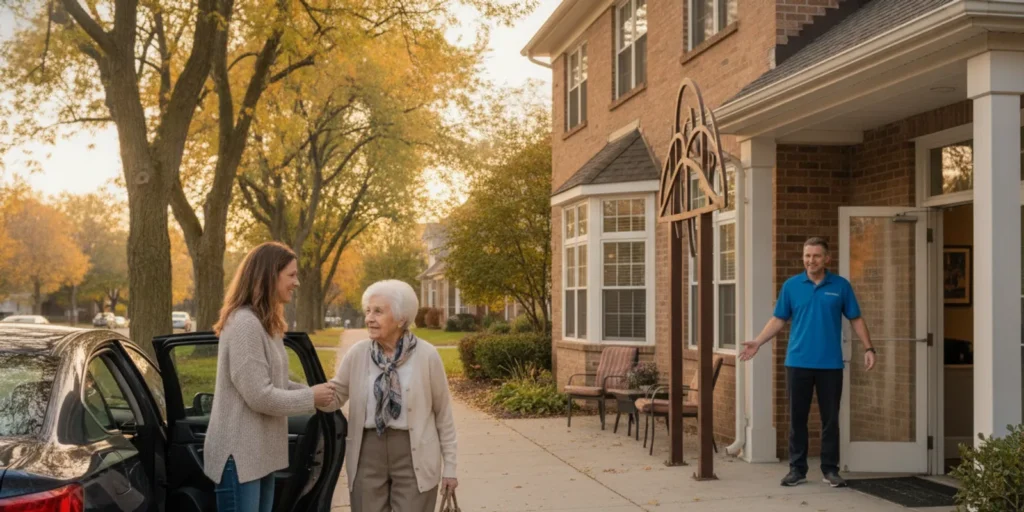
When researching assisted living in Crystal Lake, IL, transportation deserves a place on the planning list. A visit is easier to arrange when the family knows who will travel, what support the older adult may need along the way, and which details must be confirmed with the home before setting out.
Why plan transportation before a visit?
A tour or care conversation can help a family understand a residential setting and raise questions that are hard to resolve by phone. But the visit starts before anyone reaches the door. The trip itself may involve walking to a vehicle, getting in and out, bringing mobility equipment, coordinating several relatives, and allowing enough time for rest or unexpected delays. A little planning helps keep those practical needs from taking over the conversation.
Transportation also matters after a move. Family members may want to visit regularly, attend a care meeting, bring familiar belongings, or accompany a resident to an appointment. Each trip can have different needs. A one-time visit with several relatives is not the same as a recurring ride for one person with a walker, and neither tells you what services a particular home offers.
Keep the purpose of the trip clear. Are you visiting to learn about the home, to talk through care fit, or to make a routine family visit? Confirm the address, timing, accessibility, and who will meet you before leaving. For Shepherd Premier, the Crystal Lake home is listed at 5430 Hillside Rd, Crystal Lake, IL 60012. Confirm the visit details directly before you travel; an address does not establish current availability or admission suitability.
What should families clarify before setting out?
Start by asking the person you are visiting what would make the trip comfortable. If the visit is for a prospective resident, include them in decisions as much as they wish and are able to participate. They may prefer a particular time of day, a familiar companion, a short first visit, or a chance to rest before discussing care. The person’s preferences are important even when family members are coordinating the logistics.
Next, decide who is responsible for each part. One relative can confirm the appointment and address, another can arrange the ride, and a third can bring notes or questions. If one person is doing everything, write down the details in one place and share them with anyone who may be delayed or need to meet the group at the home.
- Confirm the appointment time, expected length, entrance, and a phone number to use if plans change.
- Ask whether the home has any arrival instructions, such as where visitors should meet or where to park.
- Check what mobility equipment can be brought and whether someone can help with the transition from vehicle to building.
- Agree on who will accompany the older adult and who will remain available if the visit needs to end early.
- Pack only what is useful for the visit, such as a list of questions, relevant care information, and any personal mobility items.
Do not assume that transportation, escorting, a wheelchair, or help transferring into a vehicle is provided by a senior living home. Ask the specific home what it can accommodate for a visit, and arrange any needed support in advance. If a person has a medical or mobility concern that affects travel, ask their appropriate care professional for individualized guidance rather than relying on a general article.
How can families choose a way to get there?
There is no single best way to travel for every family. A relative’s car may be simplest for one visit, while a taxi, rideshare, public transit, paratransit, or another community transportation option may suit a different trip. The right choice depends on the traveler’s abilities, distance, timing, cost, equipment, and the ride service’s rules. Confirm details with the provider rather than assuming a particular option is available or appropriate.
For a ride arranged by family, think through the full trip rather than just the drive. Is there a safe place for the passenger to wait? Can the person enter and exit the vehicle comfortably? Does the driver know where to stop and how much time is needed? If a mobility aid must fit in the vehicle, check its dimensions and how it will be secured. For a hired ride, ask the operator whether the vehicle can accommodate the person and equipment. A standard vehicle should not be assumed to provide accessible boarding or assistance.
Public transit can be another possibility, but it requires careful checking of the current route, service hours, stop locations, transfers, walking distance, and accessibility. A McHenry County human-services transportation study describes Route 808 as traveling along Highway 14 and IL-20 and connecting Crystal Lake, Woodstock, and Harvard, with service to Metra stations. That study is a planning reference, not confirmation of a current schedule, a direct trip to a specific home, or a ride suitable for a particular person. Review current information with the transit provider before relying on it: Human Services Transportation Study.
Some communities have specialized transportation programs or eligibility requirements, but the details can change and may depend on a rider’s location and needs. Ask the provider directly about enrollment, reservations, fares, service boundaries, mobility devices, companions, and cancellations. Do not schedule around an unconfirmed ride or assume a provider will take a passenger all the way to a particular entrance.
How can a family build a reliable trip plan?
Make the plan in stages. First, confirm the destination and visit time with the home. Next, choose a ride that works for the traveler and any mobility equipment. Finally, check how the group will get from the drop-off point to the meeting place. Each stage has a different person or provider to confirm with. A route that appears simple on a map may still involve a long walk, stairs, a transfer, or a wait that does not work for the person traveling.
Write down the details instead of relying on memory. Include the appointment date and time, the address, the name or number of the person to contact, the driver’s plan, and any confirmed arrival instructions. If using a transit or ride service, keep its reservation or trip information together with the home’s directions. Make sure the person arranging the trip has a way to reach the other participants if the schedule changes.
Work backward from the appointment. Estimate the travel time using current information, then allow additional time for parking, entering and exiting the vehicle, finding the entrance, and moving at the traveler’s pace. Avoid planning the arrival so tightly that one slow transfer or traffic delay makes the person feel rushed. A buffer is especially useful when a visitor has not been to the location before, but it should not mean arriving so early that the older adult is left waiting without a comfortable place to sit.
Check whether all parts of a transit journey are manageable. A trip may include a walk to a stop, waiting outdoors, boarding, a transfer, and another walk at the destination. Ask the transit provider about service and accessibility details for the intended trip. If a family member will accompany the traveler, confirm that the schedule gives both of them enough time to board and move between stops. Do not count on a driver or fellow passenger to provide physical assistance unless the service has confirmed that responsibility.
Have a backup plan that is practical, not just theoretical. If a relative is delayed, who can contact the home? If a scheduled ride is canceled, is there another provider or a family member who can help? If weather makes the route difficult, can the visit be moved to another time? Ask the home how to reschedule rather than assuming a late arrival will be accommodated. A backup plan should preserve the older adult’s comfort and avoid placing a last-minute burden on someone who cannot safely help.
Consider whether the trip involves more than one stop. Families sometimes plan a tour around an appointment, a meal, or errands. That may be convenient, but multiple stops can lengthen the day and add transitions. Ask the older adult whether combining activities feels manageable. If the person tires, has a predictable routine, or finds unfamiliar travel difficult, a direct trip may be a better plan to discuss with the family and appropriate care professionals.
After the visit, record what worked and what did not. Was the route straightforward? Did the person have enough time to get in and out of the vehicle? Was there a place to pause? Did the ride provider or home give the family clear information? Those observations can improve planning for a second visit or recurring family visits. They should not be treated as a promise that the same arrangement will work on another day or for another person.
What changes when the visit is a tour?
A tour is a chance to ask about the home and discuss whether its services may fit the person’s needs. It is not a promise of admission, room availability, a particular care arrangement, or a written rate. Transportation planning can help the family arrive ready to explore rather than rushed, but the home-specific conversation remains the place to verify care fit and current details.
Before the tour, ask how long to allow and whether the older adult should attend the entire visit. Some families find it helpful to have a short initial conversation with a staff member, then include the prospective resident in the parts that matter to them. Other families prefer to arrive together and ask questions as a group. Discuss the plan respectfully with the person rather than assuming what they want.
For a first visit, consider a route with enough flexibility to accommodate delays. If the older adult tires easily, ask whether the visit can be paced with breaks. If the person uses a mobility aid, check the route from drop-off to the meeting point. If the group is unfamiliar with the area, decide in advance which person will navigate and where everyone will meet. These are practical questions, not evidence of a particular home’s accessibility; confirm the actual arrangements with the home.
Bring a short list of priorities instead of trying to settle every family question during the ride. Examples include the kind of daily help needed, preferred routines, how the home responds when needs change, room choices, meals, activities, safety questions, pricing, and payment. A family can also review general information on assisted living services before the visit, then ask what applies at the specific location.
How do mobility and comfort affect the travel plan?
Travel needs vary from person to person and may vary from day to day. A person who usually walks independently may want an arm for balance on an unfamiliar path. Someone else may use a cane, walker, or wheelchair. A family member may know the person’s usual routine, but an unfamiliar vehicle, weather, fatigue, or a longer-than-expected wait can change what feels manageable.
Ask the traveler what support they want and what they do not want. Offer help without taking control of tasks the person prefers to do independently. If a family member will assist, agree on the plan before the trip and allow the person time to move at a comfortable pace. Keep the route free of avoidable rushing, and plan a place to pause if one is needed.
If the person uses equipment, consider the whole journey: getting it from the home to the vehicle, loading and securing it, unloading, and using it along the route. A folded walker may fit in one car but not another. A wheelchair may require a vehicle designed for it. Confirm equipment and accessibility needs with the ride provider and the destination in advance. Do not assume that a vehicle or building has a feature simply because it serves older adults.
For someone living with dementia, unfamiliar travel can sometimes be confusing or tiring. Keep directions and explanations simple, use a familiar companion when possible, and avoid changing plans repeatedly without explanation. A family knows the individual best. Consider what tends to make transitions feel easier for that person, and share relevant preferences with the person hosting the visit. This is general planning guidance, not a clinical recommendation; ask the person’s care professional about concerns specific to their situation.
It may help to schedule a visit at a time that fits the person’s established routine. If mornings are usually calmer, or a person prefers not to travel around meals, discuss possible timing when arranging the visit. Do not assume that the home can offer a particular time or schedule; confirm it. The goal is to make the trip respectful and manageable, not to impose a routine that the person does not want.
How should families coordinate a group visit?
When several relatives attend, coordination can make the visit easier for the older adult. Agree on one person to communicate with the home and share the confirmed information with everyone. Choose a meeting point, plan how the group will travel, and decide whether relatives will arrive together or separately. Too many last-minute messages can create confusion, especially if the person being visited is already managing a change in routine.
Talk ahead of time about who will ask which questions. One relative might ask about daily support, another about costs, and another about the home’s routines. Make sure the person at the center of the decision has space to speak. If relatives disagree about care options, avoid turning the ride or visit into a debate in front of the older adult. Set aside a separate time to compare notes and clarify concerns.
For a family member who cannot travel, ask whether the home can include them in a conversation by phone or another method. Do not assume a particular remote option exists; make the request when scheduling. If the prospective resident prefers a smaller group, honor that preference when possible and share information with other relatives afterward with the person’s consent.
Keep a simple record of who is driving, expected arrival times, and whom to call if someone is delayed. If different relatives are coming from different places, make sure everyone has the correct location and understands where to meet. Share only the information needed to coordinate the visit and respect the older adult’s privacy when discussing personal details.
What should families ask about recurring visits?
After a move, transportation planning can become part of a family’s routine. It helps to distinguish between getting family members to the residence and arranging transportation for the resident. These are different questions. A family may drive to visit, while a resident may have separate needs for appointments or other destinations. Do not assume that a home provides either service as a standard offering.
Ask the home which transportation arrangements, if any, are available at that location and what they cover. Clarify whether the answer refers to family visits, outings, or resident appointments. Ask who makes arrangements, whether advance notice is needed, whether there are fees, what mobility equipment can be accommodated, and whether a companion must attend. Ask about limitations and alternatives, too. A clear answer should describe what is confirmed for that home, not what might be offered elsewhere.
If relatives expect to visit regularly, talk through a realistic schedule. Consider work hours, distance, weather, vehicle access, and backup plans. A plan that depends on one family member every week may need a substitute for illness, travel, or a vehicle problem. A shared calendar can help relatives avoid missed handoffs and make it easier to tell the resident when someone is coming.
Families can also ask how to coordinate visits with the resident’s preferences and established routines. Some people enjoy frequent, spontaneous visits; others prefer a predictable day or a quieter visit with one person at a time. Ask the resident rather than imposing a schedule on them. Where appropriate, confirm any visitor procedures with the home and let relatives know what to expect.
To compare the types of care and questions that may arise, families can consult Shepherd Premier’s senior living locations directory. Then verify that the specific home offers the care type and arrangements being discussed. A directory listing is a starting point for an inquiry, not proof of present availability or an individual’s eligibility.
How can families make a first visit less stressful?
Try to keep the day simple. Confirm the appointment rather than relying on an old message, check the route and travel time, and leave a reasonable buffer. Bring water or other ordinary items the traveler prefers, if appropriate, and avoid packing so much that getting into the vehicle becomes difficult. If the person has a usual routine around meals or rest, account for it when selecting a time.
Explain what will happen in plain terms. For example, say who will be there, how the family plans to get to the home, and what the visit is for. If the older adult is unsure about moving, do not describe a tour as a decision already made. A visit can be an opportunity to gather information and express preferences. Ask what the person would like to see or know.
Plan a graceful way to shorten or reschedule the visit if the traveler becomes tired or the ride is delayed. Confirm whom to call if arrival time changes. If the appointment is part of a larger family conversation, decide which questions are most important so that a shorter visit can still be useful. A calm, respectful visit can be valuable even when it does not resolve every issue.
Afterward, give the person time to share their impressions. Ask open questions such as what felt comfortable, what seemed unfamiliar, and what they would like to learn next. Separate firsthand observations from assumptions: the family saw certain parts of the home on that visit, but may need to ask about services, staffing, pricing, or care arrangements separately. A return visit may be useful if the person wants one, but no visit guarantees a particular outcome.
What questions belong on a transportation checklist?
A short checklist can help family members prepare without turning the visit into a logistics exercise. Adapt it to the person and the purpose of the trip. If an answer is unknown, mark it for follow-up rather than guessing.
- Address and arrival: What is the exact address? Which entrance should visitors use? Where should the driver stop, and whom should the family call on arrival?
- Appointment: Is the date and time confirmed? How long should the family allow? What should they do if they are early or delayed?
- Ride: Who is driving, and who is the backup? If using a transportation provider, has the ride been booked and confirmed?
- Mobility: What equipment is needed? Will it fit in the vehicle? Has the destination confirmed the route from drop-off to the meeting place?
- Comfort: What time of day works best for the person? Would a shorter visit or rest break help?
- Support: Who will accompany the older adult? Is a second person needed to help coordinate the group?
- Questions: What are the three most important care or location questions to discuss if time is limited?
- Follow-up: Who will write down answers, share them with the person and other family members, and confirm unresolved details?
For recurring visits, add a separate checklist for the resident’s transportation needs. Ask which services are available at the particular home, who arranges them, what the limitations are, and how families should coordinate. Keep a record of the answer and the date it was confirmed, since service details and schedules can change.
How can families compare homes without assuming transportation services?
Transportation is one part of a larger care decision. A convenient trip does not by itself establish that a home meets a person’s needs. Likewise, a difficult trip does not answer whether the care setting is appropriate. Consider travel logistics alongside the services, routines, room options, costs, and care fit that the family needs to verify at each location.
When comparing homes, use the same questions at each one. Ask what help is offered, which arrangements are included, what is arranged by the family, and what should be confirmed separately. Keep answers property-specific. Two homes operated by the same provider may differ in services or practical arrangements. Do not rely on a general description to assume the same transportation, care, staffing, or pricing at every address.
It can be useful to review a guide to comparing senior living communities before a visit. Use it to organize questions, not to substitute for a direct discussion with the home. Ask about any concern that could affect day-to-day life, and request clarification if an answer is unclear or seems to describe a different location.
Keep notes factual. Instead of writing “transportation is provided,” record exactly what the home or provider said, which trip it covers, and any conditions or limits. Instead of treating a map estimate as a guaranteed journey, note that traffic, weather, mobility, and service schedules may change the actual travel time. A careful record helps family members make decisions from confirmed information.
When should families ask for a care conversation?
Reach out when you are ready to clarify a specific home’s services, visit arrangements, or fit for a person’s needs. Families do not need to have every decision settled before asking a question. A conversation can help identify what the home can confirm, what details require follow-up, and whether a visit makes sense as a next step. Bring questions about the care needs that matter most, along with practical travel constraints that may affect a visit.
If you are comparing locations, identify the exact home you want to discuss. Shepherd Premier describes assisted living and memory care at Sterling and memory care at Dixon, while its Crystal Lake home has its own location-specific information. Service descriptions for one address should not be carried over to another. The provider’s home page and location information can help orient a family, but a direct conversation is needed to confirm a particular home’s current details.
Ask whether the visit is intended as an introduction, a care discussion, or both. Tell the person you are speaking with if the older adult will need extra time to enter the building, if a mobility aid will be used, or if a family member will join remotely. These details help the home explain what it can accommodate for the planned visit. They do not guarantee a specific arrangement, so confirm the response before travel.
When the family is comparing costs, request current, itemized information for the specific home and person’s situation. A general starting figure, if encountered online, is not a personalized quote or confirmation of what is included. Ask about room and care arrangements, additional charges, payment options, and what would prompt a change in cost. Keep financial questions separate from assumptions about transportation or admission.
Frequently asked questions about transportation and visits
Does an assisted living home provide rides for family visitors?
Do not assume that it does. Ask the specific home about visitor arrival, parking, accessible entry, and any assistance it can offer. A home’s resident services, if any, are not automatically transportation services for relatives traveling to visit.
Can public transit take a family to a home in Crystal Lake?
It depends on the current route, schedule, stop location, and destination. A regional study describes a route connecting Crystal Lake with other communities, but it does not establish a direct stop at a particular residence or a current, suitable trip. Check with the transit provider and confirm the last part of the journey before relying on transit.
What should we do if the older adult uses a wheelchair or walker?
Confirm that the chosen vehicle can accommodate the person and equipment, and ask the destination about the route from drop-off to the meeting point. Arrange any assistance in advance. Do not assume a standard car, hired ride, or building entrance will meet a specific mobility need.
Should the prospective resident attend a tour?
Include the person in the decision as much as they wish and are able to participate. Ask what would make a visit comfortable, and discuss options with the home. A tour is an information-gathering opportunity, not a commitment to move or a guarantee of admission.
What if a family member cannot travel to the visit?
Ask the home whether it can include that relative by phone or another method. Confirm the option when arranging the visit and respect the older adult’s privacy and preferences about who joins the conversation.
Make the trip part of a respectful decision
Planning a ride is a practical way to support a thoughtful assisted living decision. Confirm the destination and visit details, consider the older adult’s preferences and mobility, and ask direct questions about transportation rather than assuming what a home or service provides. Then use the visit to learn about the specific location, discuss care fit, and decide together what information is still needed.