
The decision to move a parent into memory care is rarely easy. Even when it’s clearly the right choice—when the safety risks at home have become real, when the caregiving demands have exceeded what any family can reasonably provide—the transition can still leave families with a quiet, persistent question: Are they okay?
It’s one of the most human questions there is. And it deserves a real answer.
The truth is that many residents don’t just adjust to memory care—they genuinely flourish in it. The right environment, with the right people and the right rhythm of daily life, can unlock a quality of life that neither the resident nor their family expected. At Shepherd Premier Memory Care of Monticello, located at 1009 South Irving Street, we see this happen regularly. Families who visit weeks after move-in are often surprised—and moved—by what they observe.
Here are five signs that your parent is not just doing fine in memory care—but truly thriving. And for each one, we’ll share what that looks like in our home in Monticello, Illinois.
Sign #1: They Know the Caregivers’ Names
This one sounds simple. But in the context of dementia and Alzheimer’s disease, it carries real weight.
Memory impairment affects the ability to form and retain new information. When a person living with dementia begins to recognize and recall the names—or even just the faces and voices—of the people caring for them, it signals something important: they feel safe. Safety is the foundation of belonging. And belonging is the foundation of wellbeing.
In large institutional memory care settings, this kind of recognition is harder to develop. High staff turnover, large resident populations, and rotating shift schedules make it difficult for consistent relationships to form. The resident is always meeting someone new.
At Shepherd Premier of Monticello, our 20-bed home and industry-leading caregiver-to-resident ratio—never exceeding 1:6—means residents see the same familiar faces day after day. Our caregivers know their residents’ stories, preferences, and personalities. And over time, residents know them back. That familiarity is not incidental. In dementia care, it’s clinical.
What to look for: On your next visit, pay attention to how your parent interacts with staff. Do they respond warmly when a caregiver enters the room? Do they call anyone by name, or light up when certain people walk in? These are signs of real connection—and real thriving.
Sign #2: They Have a Routine That Feels Like Their Own
Predictability is not a limitation in dementia care—it’s a lifeline. Research consistently shows that structured daily routines reduce anxiety, agitation, and confusion in individuals living with Alzheimer’s and related dementias. When a person knows—even on a subconscious, bodily level—what comes next, the world feels less threatening.
Thriving residents have a rhythm to their days. They wake at a consistent time. They have a seat they prefer at the dining table. There’s a morning activity they look forward to, an afternoon rest they’ve come to expect. That structure isn’t imposed on them—it’s been shaped around them.
At Shepherd Premier of Monticello, individualized care plans are the foundation of everything we do. When a new resident joins our home, our team takes time to learn their history: their lifelong habits, their preferences, the things that comfort them and the things that agitate them. A care plan is built around that person—not around administrative convenience.
What to look for: Notice whether your parent seems oriented to their day during your visits. Do they mention an activity they did that morning? Do they seem to know where they’re going next? A resident who moves through their day with a sense of familiarity and calm is a resident who has found their footing.
Sign #3: They’re Engaged in Activities They Enjoy
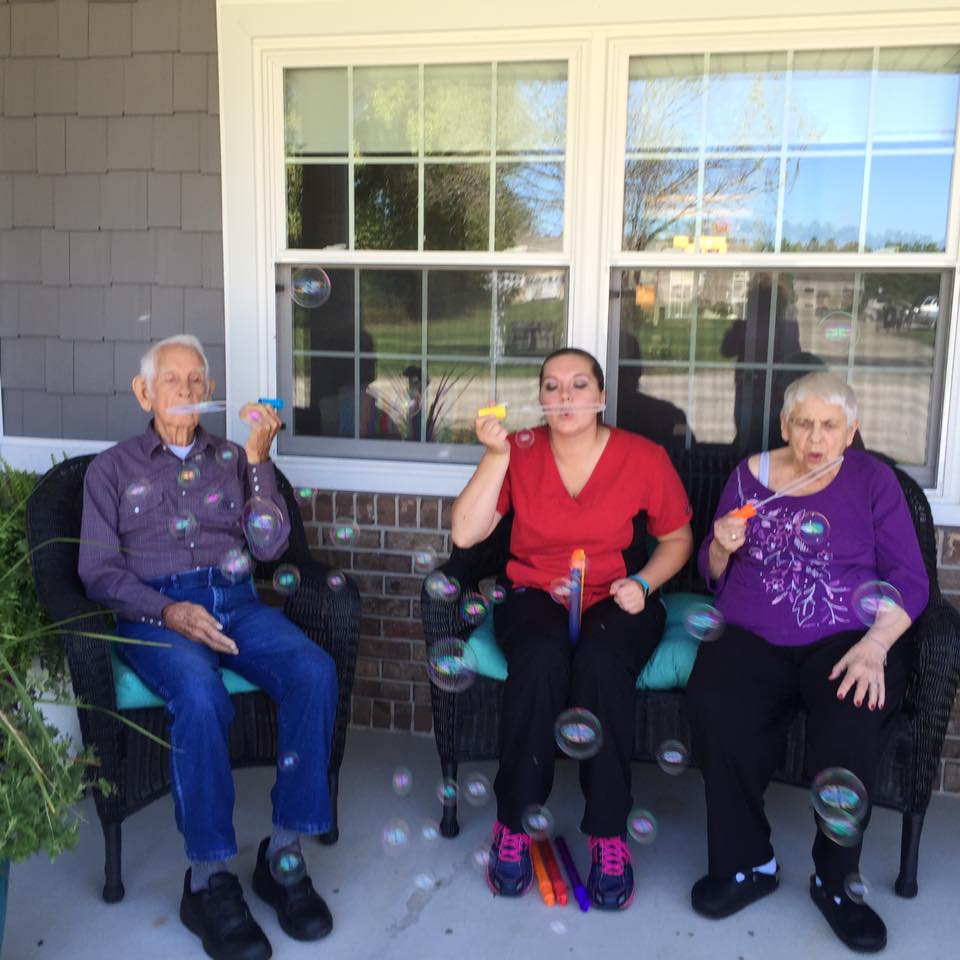
Joy doesn’t disappear with a dementia diagnosis. It finds new expressions, new triggers, new forms—but the capacity for pleasure, laughter, and engagement remains present far longer than many families expect. One of the most powerful indicators that a loved one is thriving in memory care is that they’re participating in things that bring them genuine delight.
This looks different for every person. For one resident, it’s music—a song from their youth that cuts through the fog of confusion and produces a smile that their family recognizes immediately. For another, it’s the simple act of helping fold laundry, or tending to a small plant, or sitting at the table while something is being baked in the kitchen. Familiarity and sensory engagement are powerful medicine.
At Shepherd Premier of Monticello, we offer music therapy as part of our programming—a practice with documented cognitive and emotional benefits for individuals with Alzheimer’s and dementia. Beyond that, our daily activities are designed to be purposeful and sensory-rich: light exercise, art projects, cooking participation, gardening, and social time that encourages connection without overwhelming.
Because our home is small, our team can tailor activities to what individual residents actually enjoy—not just what’s easiest to offer at scale. If your parent spent forty years baking bread, we know that. We find ways to bring that to life.
What to look for: Ask the caregiving team what your parent has been doing—and watch their face when they tell you. Better yet, ask your parent. Even if the details are fuzzy, a resident who is engaged will often be animated when activities come up. That animation is joy. It’s thriving.
Sign #4: They’re Eating Well and Sleeping Through the Night
These two markers—nutrition and sleep—are among the most reliable indicators of overall wellbeing in memory care residents, and among the most commonly disrupted in poor care environments.
Disrupted sleep is common in dementia, but it is also dramatically influenced by environment and routine. Noise, unfamiliar surroundings, inconsistent schedules, and inadequate staffing during nighttime hours all compound sleep disturbance. A resident who is sleeping through the night—or waking with a calm, consistent response from a caregiver they trust—is in an environment that supports their biology.
Nutrition tells a similar story. Loss of appetite, weight loss, and disinterest in food are common warning signs of depression, over-medication, or environmental stress in memory care residents. A resident who is eating well—who looks forward to mealtimes, who has preferences about what they eat, who participates in the social ritual of a shared meal—is a resident who feels at home.
At Shepherd Premier of Monticello, meals are home-cooked and served in a setting that feels like a family dining room—because it is. Residents participate in meal planning and preparation when they’re able. Snacks are available throughout the day. Our small size means caregivers notice immediately if a resident’s appetite shifts, and can respond before a small concern becomes a larger one.
What to look for: Ask staff about your parent’s sleep patterns and appetite. Are they eating most of what’s served? Sleeping through the night? These aren’t glamorous indicators—but they’re honest ones. Consistent sleep and good nutrition are the quiet infrastructure of a thriving life.
Sign #5: You Leave Visits Feeling Reassured, Not Worried
This last sign is about you—the family member. And it matters more than people realize.
Families who are actively involved in a loved one’s memory care journey develop an intuition over time. You know your parent. You’ve watched them across decades of life. You can feel when something is off, even when you can’t articulate exactly what it is. That intuition is a signal worth trusting.
When a parent is truly thriving in memory care, visits feel different. You arrive and find them calm, even if not always lucid. You observe warmth between them and their caregivers. You have real conversations with the staff—people who know your parent’s name, who ask how you are doing, who bring you into the picture rather than keeping you at arm’s length. You leave with a sense of peace that doesn’t require you to override your instincts. It comes naturally.
At Shepherd Premier Senior Living, family involvement is not just welcomed—it is considered part of the care itself. We believe that a resident’s family is an extension of our care team. Open visiting, regular communication, and an honest relationship between caregivers and families are non-negotiable parts of how we operate.
What to look for: Pay attention to how you feel after a visit. Are you leaving with peace of mind or with a knot in your stomach? Trust that. And if something doesn’t feel right—at any facility—advocate loudly for your loved one. In a thriving placement, families don’t have to fight to feel informed.
What Makes the Difference: The Shepherd Premier Approach in Monticello
These five signs of thriving don’t happen by accident. They’re the product of intentional care—an environment designed from the ground up to support human connection, dignity, and quality of life for people living with memory impairment.
At Shepherd Premier Memory Care of Monticello—formerly known as Arbor Rose of Monticello, a name many Piatt County families still carry—we’ve built our home around a few core commitments:
- A small-home setting (20 beds) that allows real relationships to form between residents and caregivers
- A caregiver-to-resident ratio that never exceeds 1:6—giving every resident more individualized attention than larger facilities can offer
- Specialized dementia and Alzheimer’s training for every member of our care team
- Faith-inspired, relationship-centered care that treats every resident as a whole person, not a diagnosis
- All-inclusive pricing with no surprise add-ons, so families can plan with confidence
These aren’t marketing promises. They’re the reasons our families stay. They’re the reasons our residents thrive.
Serving Families Throughout Piatt County and Central Illinois
Shepherd Premier of Monticello is proud to serve families not just in Monticello, but throughout the surrounding region. Families from Champaign, Urbana, Decatur, Farmer City, Mahomet, Clinton, and other central Illinois communities regularly choose our home because of its reputation for genuine, boutique-style care that larger facilities in those markets simply cannot replicate.
We understand that for some families, the drive to Monticello for visits is a consideration. We’d invite you to think of it this way: the peace of mind you gain from knowing your loved one is truly cared for—that they know their caregivers’ names, that they sleep well, that they smile during music therapy—is worth the drive. Every time.
Other Shepherd Premier Locations in Illinois
If you’re exploring memory care or assisted living options in other parts of Illinois, Shepherd Premier operates a growing family of boutique homes. Learn more about our Charleston, IL location, our Robinson, IL location, and our Crystal Lake, IL location. Each home carries the same commitment to small-home, relationship-centered care.
Come See It for Yourself
The best way to know whether Shepherd Premier of Monticello is the right home for your loved one is to visit. Walk the hallways. Meet the team. Sit in the living room and feel what it’s like. We believe the environment speaks for itself.
We welcome families without pressure or sales pitches—just an honest conversation about your loved one’s needs and an open door to everything we do.
Visit us at 1009 South Irving Street, Monticello, IL 61856, or reach out today:
Schedule a Tour or Ask Us Anything | Call or Text: (847) 961-2551
Learn more about our mission and founding story: About Shepherd Premier Senior Living
Shepherd Premier Memory Care of Monticello (formerly Arbor Rose of Monticello) — 1009 S Irving St, Monticello, IL 61856 — (847) 961-2551